
Do you know Fougasse? You do, I’m sure. When A. A. Milne added an introduction to a 1922 collection of cartoons called Drawn at a Venture, he confessed that all drawing was, to him, a mystery. Were it not so honest an admission, I would pooh-pooh that notion. The drawings, though, were a hardbound volume of Cyril Kenneth Bird’s work ~ a Royal Engineer turned illustrator, whose work first appeared in Punch Magazine, in 1916, after he’d been invalided home from Gallipoli.

FOUGASSE ~ THE CARTOONIST
Bird’s cartoons were beyond popular, because they helped readers of all kinds to get the joke, without needing to fill in the blanks. Where others drew every detail, Bird focused on one message ~ or Punchline ~ at a time.
In the early years of the Second World War, he must have seemed an obvious choice for the Ministry of Information, which had to convey hard-hitting messages, in simple terms. Pithy captions and amusing pictures did the trick. His distinctive style with a red border was adopted by other Ministry artists ~ it’s been imitated thousands of times. To avoid confusion with his fellow Punch cartoonist W. Bird ~ a pseudonym used by Jack Butler Yeats ~ Bird chose the pen name ‘Fougasse’.
FOUGASSE ~ THE WEAPON
That word, ‘Fougasse’, comes, ultimately, from the Latin word focus, meaning hearth or fireplace. Leaving aside a rather delicious flat bread of the same name, there’s plenty of evidence that les fougasses were well-known to military engineers by the mid-eighteenth century: in short, it’s an improvised mortar that’s made by digging out a hollow in the ground and filling that with explosives and potential projectiles. I say ‘potential’. When a fougasse gets agitated for real, there’s an awful lot of guesswork involved, and even more footwork in getting the hell out of there as fast as possible.
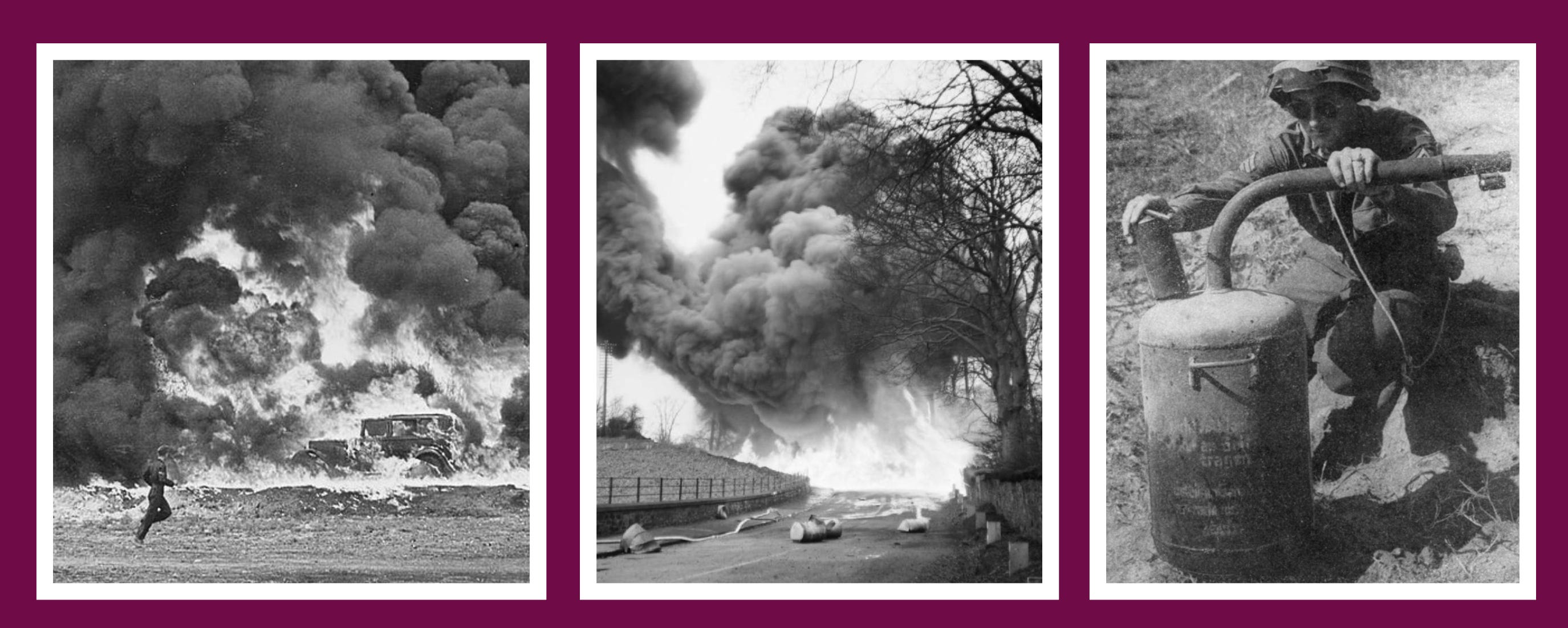
The flame fougasse was developed by Britain’s Petroleum Warfare Department. Usually made with a forty-gallon drum, dug into the roadside and camouflaged near a corner, steep incline or roadblock where vehicles had to slow down. Ammonal, when triggered, caused it to shoot a flame some ten feet wide, over a distance of thirty yards. Nasty. And no less so for coming in three forms. The safety fougasse ~ the most common, which allowed the propelling charge to be stored separately, installed only when needed and detonated electrically; the demigasse ~ a straightforward barrel-version, which would flip over and spill its flammable contents across some thirty-six square yards; and the hedge hopper ~ a fougasse with ideas above its station, designed to literally ‘hop’ up some ten feet and ten yards forward. Mostly quick and relatively easy to set up and install ~ though the hedge hopper was tricky enough that the War Office discouraged its use. Hellish, if you’re on the receiving end.
In November 1944, the US War Department Intelligence Bulletin recorded the first use of ‘fougasse flame throwers’ in this war, as having been in Soviet defences around Moscow, in 1941. The Germans had their own version ~ Abwehrflammenwerfer 42 ~ copied from a Russian FOG-1 mine they encountered during Operation Barbarossa. A stream of burning fuel some fifteen feet wide and nine feet high, with a range of about ninety feet. Equally nasty.
The word itself, ‘Fougasse’, comes, ultimately, from the Latin word focus, meaning hearth or fireplace. Leaving aside a delicious flat bread of the same name, there’s plenty of evidence that les fougasses were well-known to military engineers by the mid-eighteenth century: in short, a fougasse is an improvised mortar that’s made by digging out a hollow in the ground and filling that hole with explosives and potential projectiles. I say ‘potential’: when a fougasse is used for real, there’s a lot of guesswork involved, and even more foot-work in getting the hell out of there as fast as possible.
FOUGASSE ~ MAKING THE MAPS
And now we come to my Fougasse. The mapmaker. With the outbreak of war in 1939, Kenneth Bird ~ Fougasse ~ offered his services free of charge to any Ministry that wanted him to design posters, or provide artwork. Hitler and Goering turned up in the unlikeliest places ~ Careless Talk Costs Lives, et al.
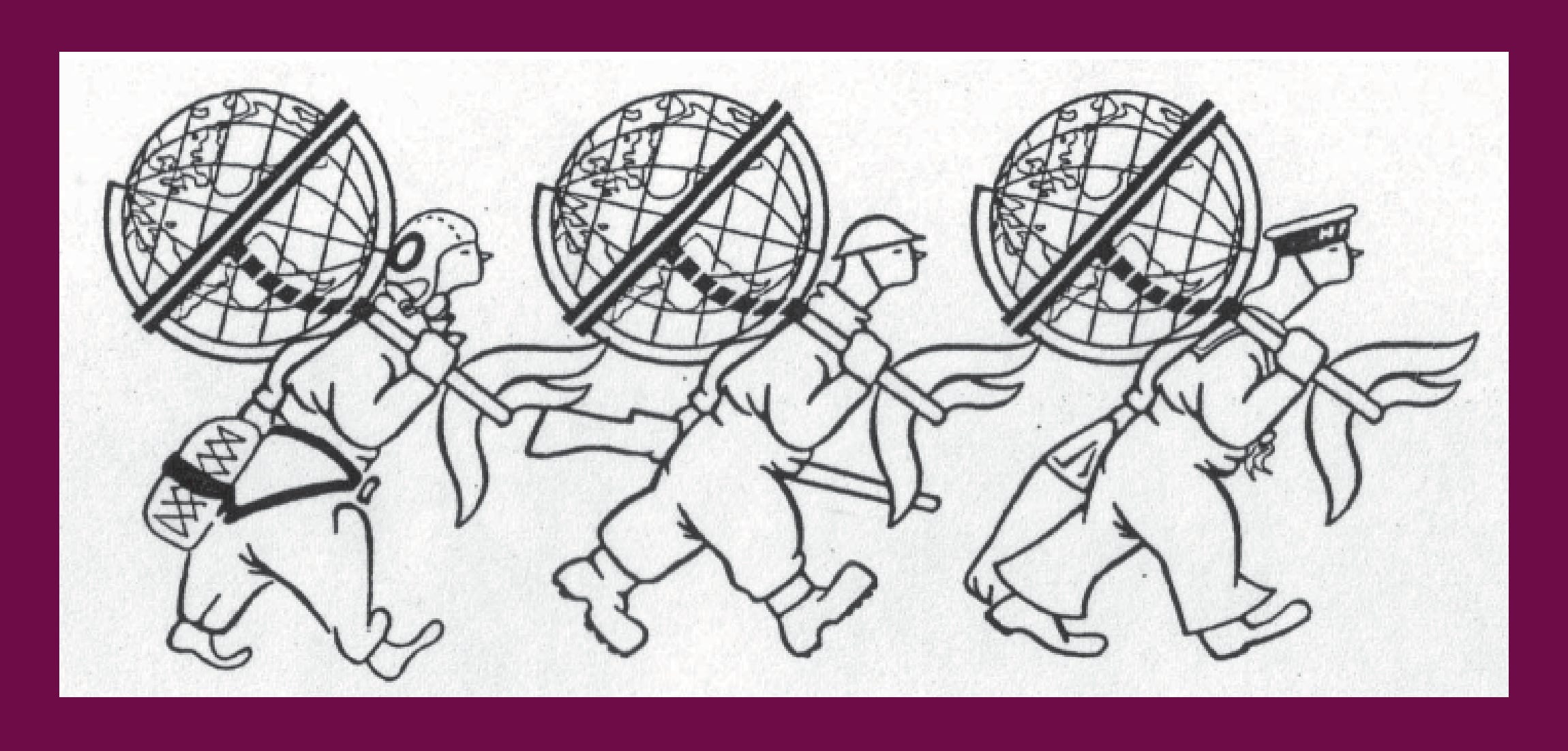
There’s never been proof. We cannot be sure. But when a man of a certain style was then added to the cover of a training manual in 1943, showing the way according to the Directorate of Military Survey ~ we can, fairly confidently, join the dots.
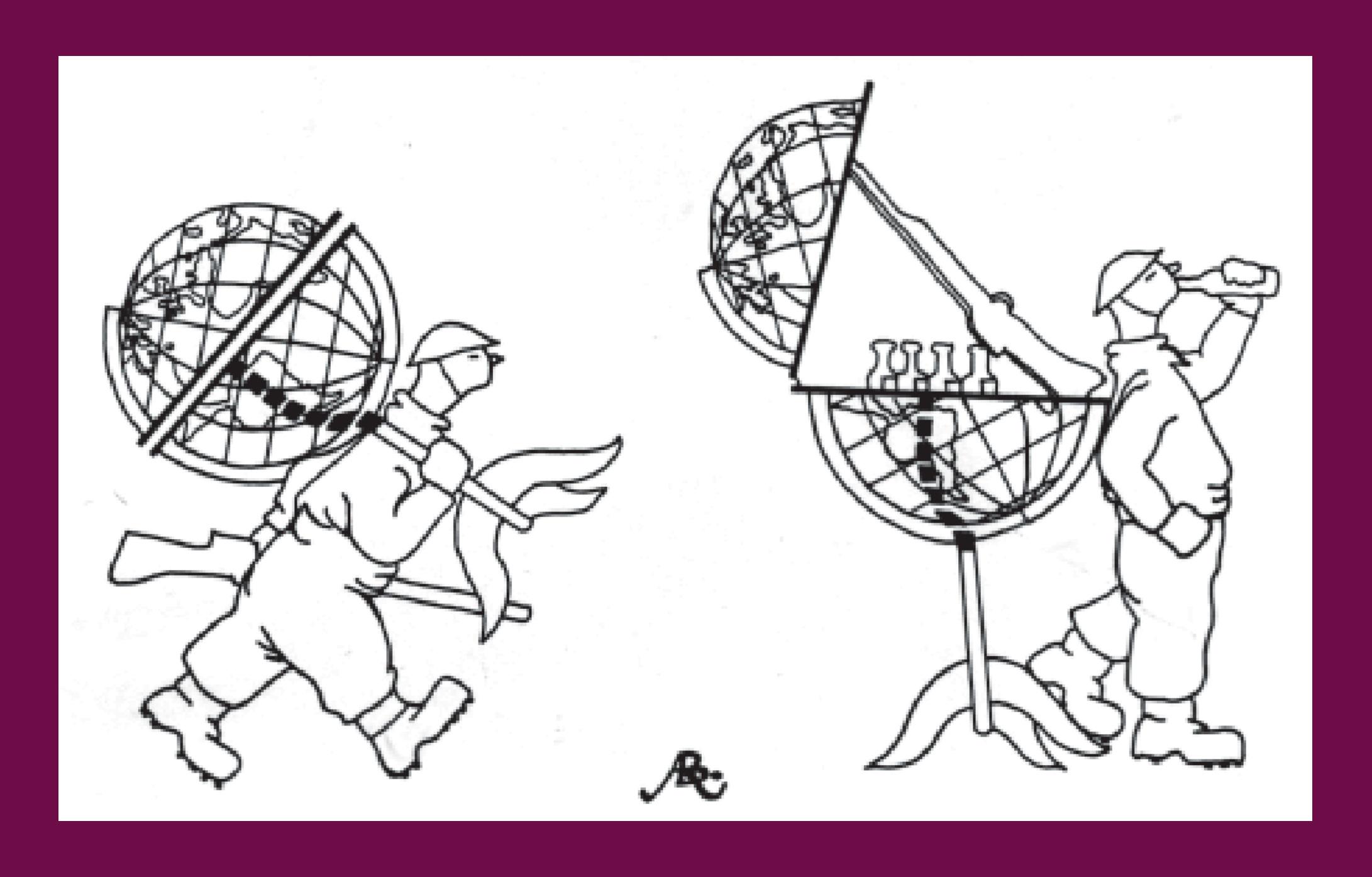
It’s a few simple lines. A mighty globe, a best foot forward, and ~ depending on the era in which Fougasse was then leading the illustrative way for defence surveyors ~ an array of headwear, and clothing, and odd bits of kit. He tried an American uniform on for size once, in one of SHAEF’s aeronautical chart catalogues, but the less said about that the better. Charts vs. Maps ~ discuss. In 1983, Soldier magazine offered a version showing Fred ~ as he was now known ~ revealing the truth about the globe he always carries. Inside it? A drinks cabinet. Again, the less said, the better.
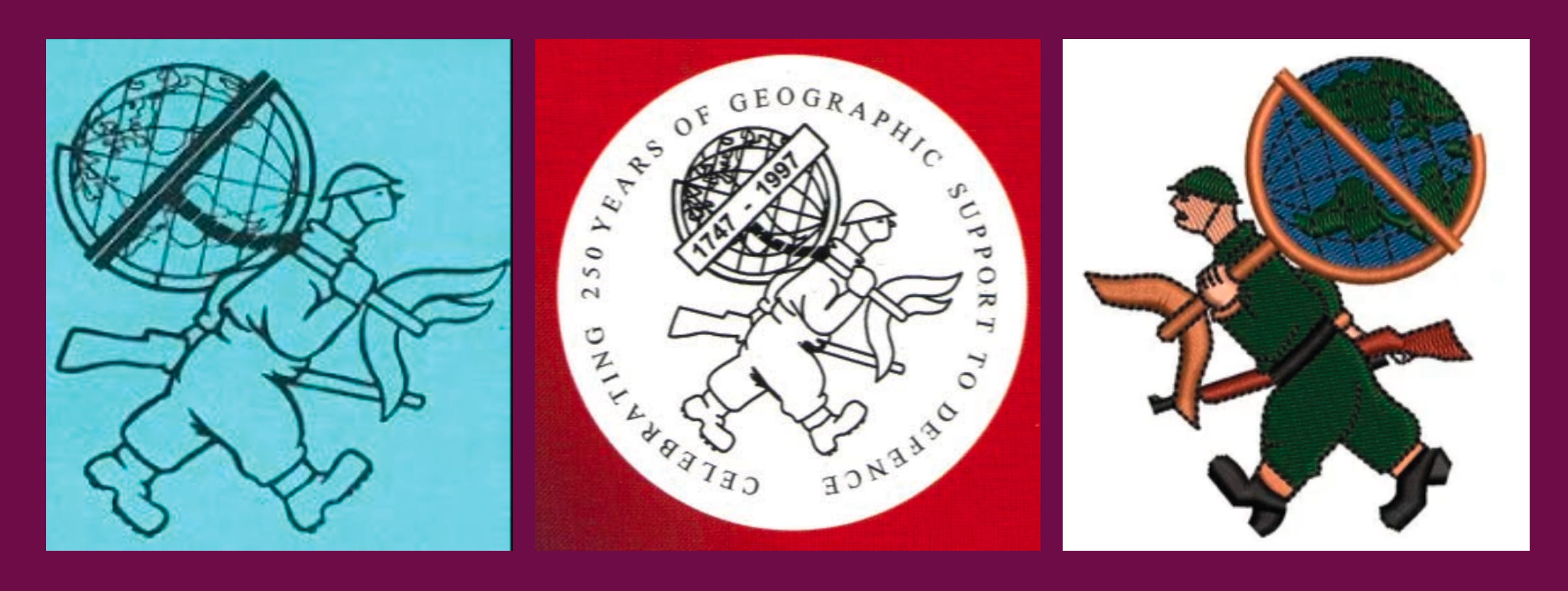
Like all good British military surveyors, Fred joined the Military Survey Branch of the Royal Engineers Association. He still appears on their website, and was adopted with great fondness by the Defence Surveyors’ Association ~ an organisation celebrating its centenary next year. I’m a member. I’m more than proud to sit on its Council.
Fougasse is still hard at work today. 42 Engineer Regiment ~ Geographic ~ still has a strong association with him. The regiment was formed in 1947, when a cadre from 19 Topographic Squadron went to Egypt as 19 Field Survey Regiment; that was renamed 42 Survey Engineer Regiment in August 1948, and absorbed 13 Field Survey Squadron then or thenabouts. After many years at Denison Barracks in Hermitage, the regiment moved to RAF Wyton in Cambridgeshire in 2014. Today it provides the British Army’s field deployable geographic services ~ survey, terrain analysis, geospatial intelligence ~ through four squadrons: 13 and 14 Geographic Squadrons, 16 Geographic Support Squadron and 135 Geographic Squadron, the Army Reserve squadron based in Ewell, Surrey. Best foot forward, still.
I like Fred. He reminds me, how pragmatic the discipline of defence mapping has to be. Best foot forward carrying the whole world in your arms, wherever it may take you or wherever the maps need to go ~ albeit, perhaps, sometimes with a drink in hand.
Fougasse! AS a Sapper in 1980 we deployed a fuel Fougasse on the range at Sheppy, Non were impressed, non had experience of it, it involved digging it so everyone lost interest quickly. I dug it in alone. Wired for electrics for detonation, stood well back 100m in the bunker. I pressed the button on those hugely heavy wind up batteries. Before srike was adopted. I was impressed mainly bu the fear it generated in everyon, the rushing in of air, the never ending expanding heated fuel getting nearer.
I never saw or used one again except in the dems manual.
Awesomeness!